Exam practice your DP students can do outside class
Each student gets the whole course for their subjects: exam-style questions marked point by point against a markscheme, timed mock papers and a predicted grade for each paper. It sits alongside your lessons and the resources you already use, and teachers don’t have to prepare anything.
Free pilot for one term. After that, £35 a year per student for each subject they take.
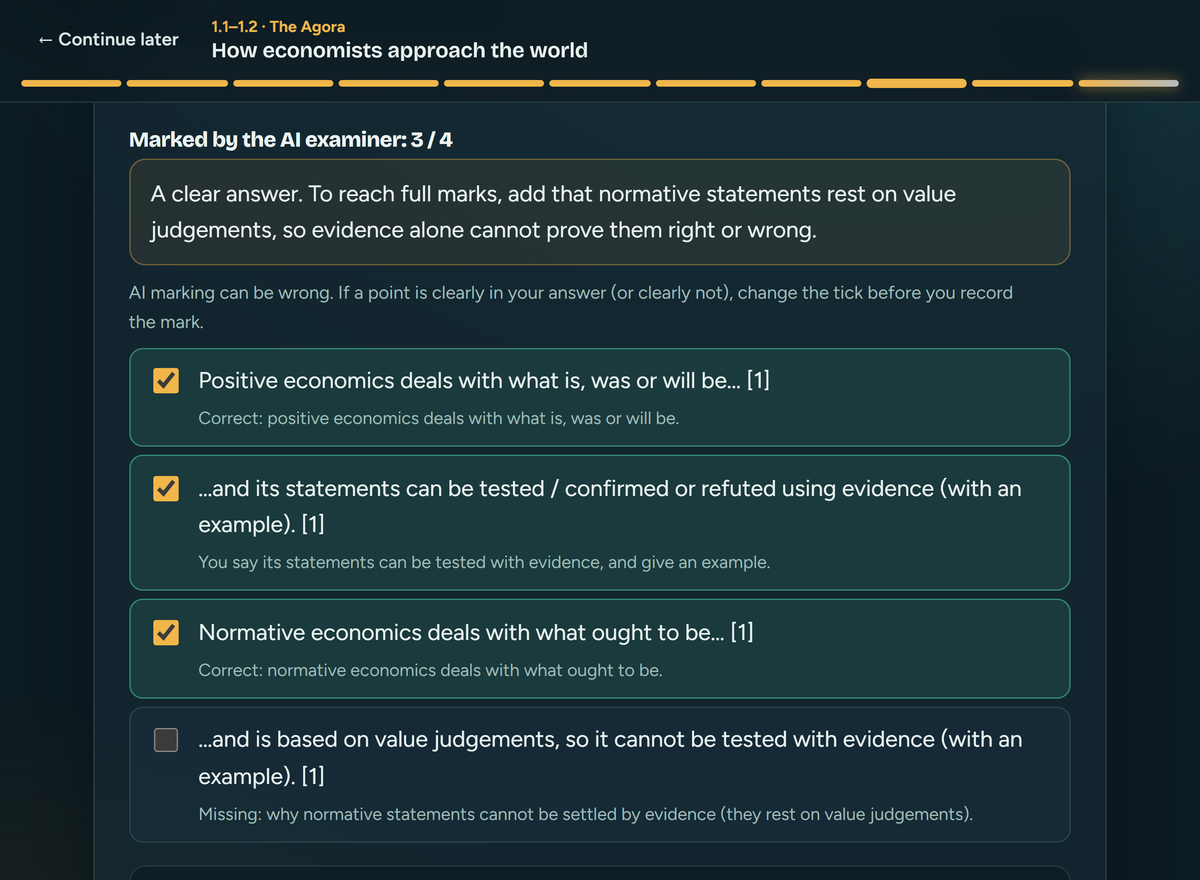 Example answer
Why it helps your students
Practice that looks like the exam, with feedback they can act on the same evening.
- Questions marked against a markschemeEvery stage ends with an exam-style question with its command term and marks. Students see which marking point they got and which they missed.
- A predicted grade for each paperBuilt from their stages and mocks with the weighting of each paper, so they can see which paper is pulling the grade down.
- Mock papers, timedIn the format of each paper, at SL and HL, ready for the weeks before the mocks.
- Mistakes come backA question they get wrong returns in their daily review after one day, then four, then twelve. Last term’s topics are still there in May.
What a teacher can see, if they want to
Optional: students can use 7Quest without a teacher ever opening it. Real screens from a sample class; the students and results are made up.
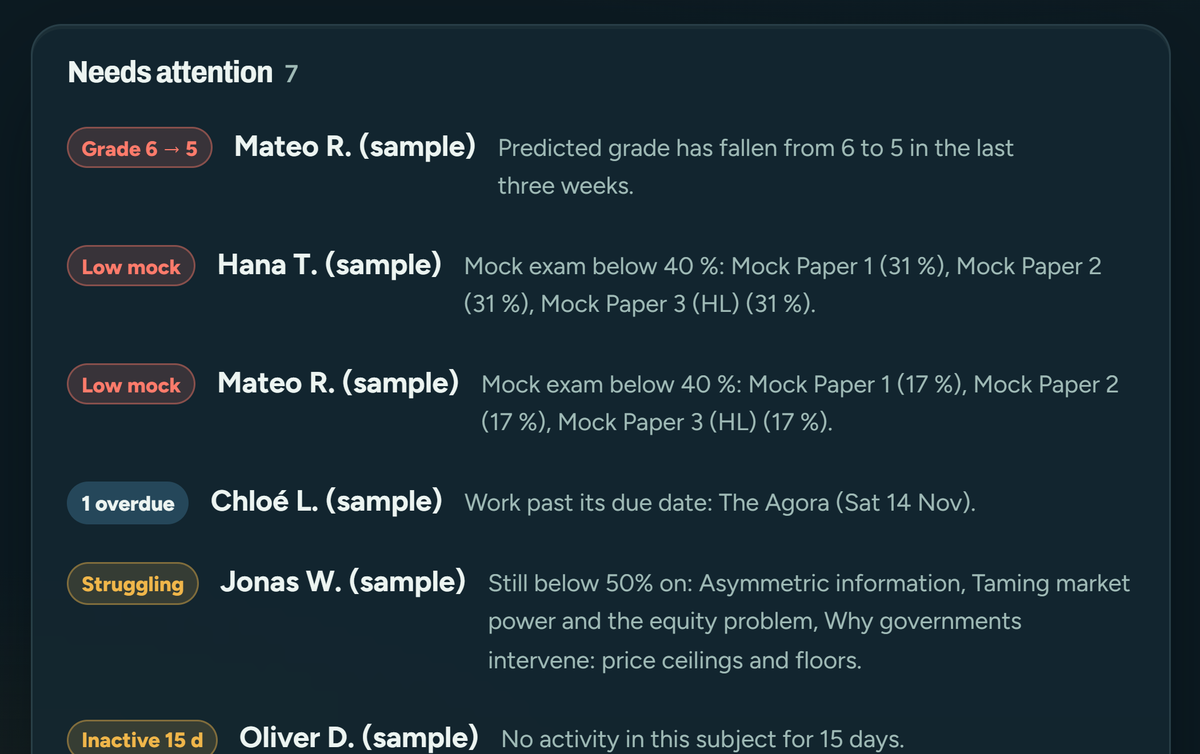
Who needs a nudge
Whose predicted grade is falling, who did badly in a mock, who is stuck below 50% on a stage and who hasn’t opened the subject for a week.
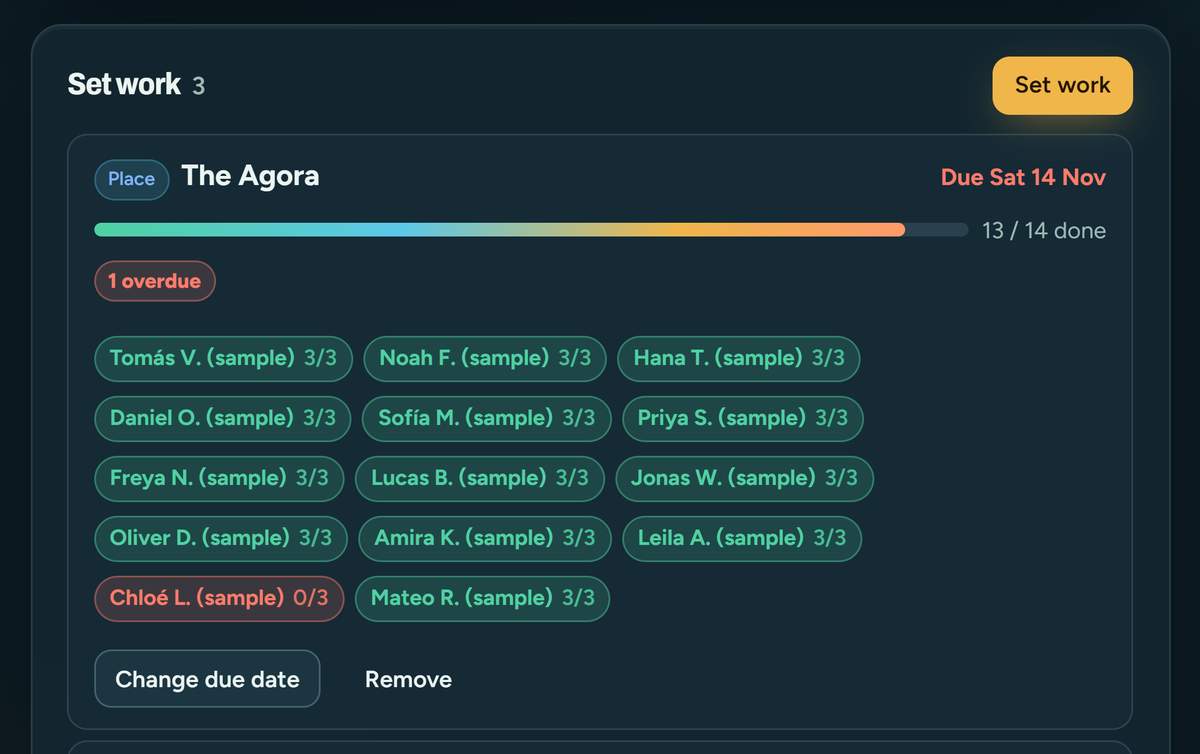
Work you set, marked as they finish
Set a stage, a mock or a whole topic with a due date. Each student’s result shows up as they finish, and late work is flagged.
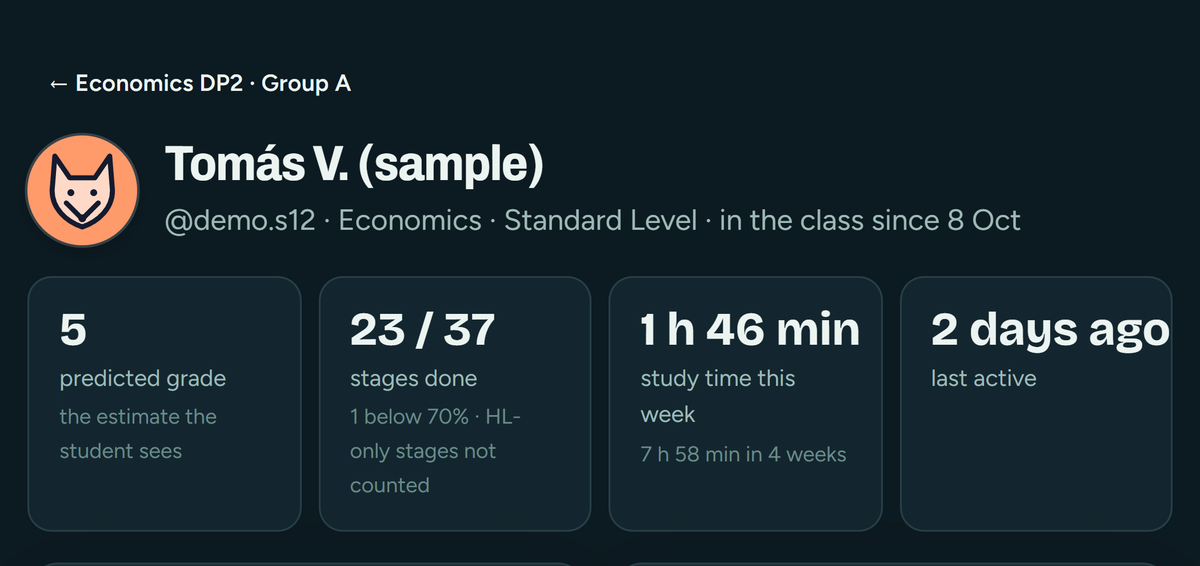
Where each student stands
Predicted grade, stages done, study time and when they were last active. Their page also has the grade week by week and every stage. Only the subject you teach, never their other subjects.
What each subject covers
Each subject follows its current guide, block by block, with the guide’s own topic codes. Open a subject to see where each topic sits on the map.
Computer Science9 topics · 75 stages · 22 HL only · 2 mock papers
| Guide | Topic · place on the map | Stages |
|---|---|---|
| A1 | Computer fundamentalsSilicon Core · practice test | 144 HL only |
| A2 | NetworksNetwork Hub · practice test | 81 HL only |
| A3 | DatabasesDeep Archive · practice test | 93 HL only |
| A4 | Machine learningSynthetic Mind · practice test | 106 HL only |
| B1 | Computational thinkingThinking Workshop · practice test | 3 |
| B2.1, B2.3 | Programming fundamentalsCode Forge · practice test | 6 |
| B2.2, B2.4–B2.5 | Data structures, algorithms and filesAlgorithm Engine · practice test | 71 HL only |
| B3 | Object-oriented programmingObject Citadel · practice test | 83 HL only |
| B4.1 | Abstract data types (HL)Data Vault · practice test | 44 HL only |
| Exam | Exam preparationThe Mainframe | 6 |
Timed mock papers: Paper 1, Paper 2. A practice test on every topic, with new questions. Every stage of Computer Science
Economics8 topics · 54 stages · 11 HL only · 3 mock papers
| Guide | Topic · place on the map | Stages |
|---|---|---|
| 1.1–1.2 | Introduction to economicsThe Agora · practice test | 3 |
| 2.1–2.6 | Microeconomics: competitive marketsMarket Square · practice test | 72 HL only |
| 2.7–2.9 | Microeconomics: government and market failureCivic Quarter · practice test | 5 |
| 2.10–2.12 | Microeconomics: information, market power and equity (HL)The Boardroom · practice test | 66 HL only |
| 3.1–3.3 | Macroeconomics: measuring and modelling the economyThe Observatory · practice test | 6 |
| 3.4–3.7 | Macroeconomics: inequality and policyBank Street · practice test | 6 |
| 4.1–4.6 | The global economy: trade and exchange ratesThe Harbour · practice test | 81 HL only |
| 4.7–4.10 | The global economy: developmentThe Frontier · practice test | 5 |
| Exam | Assessment: papers, IA and mocksThe Exchange | 82 HL only |
Timed mock papers: Paper 1, Paper 2, Paper 3. A practice test on every topic, with new questions. Every stage of Economics
Physics11 topics · 60 stages · 16 HL only · 2 mock papers
| Guide | Topic · place on the map | Stages |
|---|---|---|
| A.1–A.2 | Kinematics, forces and momentumLaunch Bay · practice test | 7 |
| A.3–A.4 | Work, energy, power and rigid bodiesFlywheel Hall · practice test | 42 HL only |
| A.5 | Galilean and special relativityLight Clock · practice test | 33 HL only |
| B.1–B.4 | Thermal energy, greenhouse effect, gases and thermodynamicsThermal Lab · practice test | 72 HL only |
| B.5 | Current and circuitsCircuit Deck · practice test | 4 |
| C.1–C.2 | Simple harmonic motion and the wave modelOscillator Room · practice test | 41 HL only |
| C.3–C.5 | Wave phenomena, standing waves and the Doppler effectWave Tank · practice test | 51 HL only |
| D.1 | Gravitational fieldsOrbit Station · practice test | 42 HL only |
| D.2–D.4 | Electric and magnetic fields, and inductionMagnet Hall · practice test | 62 HL only |
| E.1–E.2 | The structure of the atom and quantum physicsSpectrometer · practice test | 42 HL only |
| E.3–E.5 | Radioactive decay, fission, fusion and starsReactor Core · practice test | 61 HL only |
| Exam | Exam preparationControl Room | 6 |
Timed mock papers: Paper 1, Paper 2. A practice test on every topic, with new questions. Every stage of Physics
Mathematics AA13 topics · 77 stages · 29 HL only · 3 mock papers
| Guide | Topic · place on the map | Stages |
|---|---|---|
| 1.1–1.4, 1.8 | Sequences, series and financial mathsThe Staircase · practice test | 4 |
| 1.5, 1.7 | Exponents and logarithmsLog Tower · practice test | 4 |
| 1.6, 1.9–1.11, 1.15–1.16 | Proof, the binomial theorem and algebraPascal’s Pyramid · practice test | 75 HL only |
| 1.12–1.14 | Complex numbersArgand Plaza · practice test | 44 HL only |
| 2.1–2.7 | Functions, graphs and quadraticsParabola Bridge · practice test | 5 |
| 2.8–2.16 | Transformations and families of functionsTransformation Gallery · practice test | 63 HL only |
| 3.1–3.3 | Geometry and triangle trigonometrySolids Garden · practice test | 4 |
| 3.4–3.11 | Circular functions and trigonometric equationsUnit Wheel · practice test | 62 HL only |
| 3.12–3.18 | Vectors, lines and planesVector Observatory · practice test | 55 HL only |
| 4.1–4.4, 4.10 | Statistics and regressionData Towers · practice test | 4 |
| 4.5–4.9, 4.11–4.14 | Probability and distributionsGalton Board · practice test | 72 HL only |
| 5.1–5.4, 5.6–5.9, 5.12–5.14 | DifferentiationTangent Ridge · practice test | 62 HL only |
| 5.5, 5.10–5.11, 5.15–5.19 | Integration and differential equationsArea Terraces · practice test | 74 HL only |
| Exam | Exam preparationThe Summit | 82 HL only |
Timed mock papers: Paper 1, Paper 2, Paper 3. A practice test on every topic, with new questions. Every stage of Mathematics AA
Chemistry14 topics · 84 stages · 24 HL only · 2 mock papers
| Guide | Topic · place on the map | Stages |
|---|---|---|
| S1.1–S1.3 | Particles, atoms and electronsSpectral Lamp · practice test | 51 HL only |
| S1.4–S1.5 | The mole and ideal gasesMole Balance · practice test | 6 |
| S2.1 | The ionic modelSalt Lattice · practice test | 3 |
| S2.2 | The covalent modelModel Kit · practice test | 83 HL only |
| S2.3–S2.4 | Metallic bonding and materialsMaterials Workshop · practice test | 3 |
| S3.1 | The periodic tablePeriodic Wall · practice test | 51 HL only |
| S3.2 | Organic compounds and spectroscopyCarbon Library · practice test | 74 HL only |
| R1.1–R1.4 | Energetics: enthalpy, fuels and spontaneityThe Calorimeter · practice test | 93 HL only |
| R2.1 | Amounts of chemical changePilot Reactor · practice test | 3 |
| R2.2 | Rates of reactionKinetics Rig · practice test | 63 HL only |
| R2.3 | Chemical equilibriumEquilibrium Chamber · practice test | 31 HL only |
| R3.1 | Acids and basesTitration Station · practice test | 73 HL only |
| R3.2 | Redox and electrochemistryVoltaic Cell · practice test | 72 HL only |
| R3.3–R3.4 | Radicals, nucleophiles and electrophilesReflux Tower · practice test | 63 HL only |
| Exam | Exam preparationThe Crucible · practice test | 6 |
Timed mock papers: Paper 1, Paper 2. A practice test on every topic, with new questions. Every stage of Chemistry
Biology14 topics · 101 stages · 35 HL only · 2 mock papers
| Guide | Topic · place on the map | Stages |
|---|---|---|
| A1.1–A2.3 | Water, nucleic acids, cells and virusesPrimordial Pool · practice test | 83 HL only |
| A3.1–A4.2 | Diversity, classification, evolution and conservationTree of Life · practice test | 72 HL only |
| B1.1–B1.2 | Carbohydrates, lipids and proteinsMolecule Forge · practice test | 41 HL only |
| B2.1–B2.3 | Membranes, organelles and cell specializationMembrane Gate · practice test | 63 HL only |
| B3.1–B3.3 | Gas exchange, transport, muscle and motilityHeart Chamber · practice test | 73 HL only |
| B4.1–B4.2 | Adaptation to environment and ecological nichesBiome Terrace · practice test | 4 |
| C1.1–C1.3 | Enzymes, cell respiration and photosynthesisThe Powerhouse · practice test | 95 HL only |
| C2.1–C2.2 | Chemical and neural signallingSynapse Junction · practice test | 64 HL only |
| C3.1–C3.2 | Integration of body systems and defence against diseaseBody Command · practice test | 71 HL only |
| C4.1–C4.2 | Populations, communities, energy and matterFood Web Meadow · practice test | 6 |
| D1.1–D1.3 | DNA replication, protein synthesis and mutationDouble Helix · practice test | 73 HL only |
| D2.1–D2.3 | Cell division, gene expression and water potentialThe Spindle · practice test | 74 HL only |
| D3.1–D3.3 | Reproduction, inheritance and homeostasisMendel’s Garden · practice test | 83 HL only |
| D4.1–D4.3 | Natural selection, stability and climate changeGalápagos Shore · practice test | 73 HL only |
| Exam | Exam preparationThe Microscope · practice test | 8 |
Timed mock papers: Paper 1, Paper 2. A practice test on every topic, with new questions. Every stage of Biology
Business Management13 topics · 84 stages · 28 HL only · 3 mock papers
| Guide | Topic · place on the map | Stages |
|---|---|---|
| 1.1–1.3 | What is a business? Entities and objectivesThe Launchpad · practice test | 6 |
| 1.4–1.6 | Stakeholders, growth and multinationalsStakeholder Globe · practice test | 4 |
| Toolkit | Toolkit: strategic analysisThe Strategy Wall · practice test | 73 HL only |
| 2.1–2.3 | HRM, organizational structure and leadershipThe Org Chart · practice test | 4 |
| 2.4–2.7 | Motivation, culture, communication and employee relationsMotivation Pyramid · practice test | 74 HL only |
| 3.1–3.4 | Finance, costs and final accountsThe Ledger · practice test | 61 HL only |
| 3.5–3.6 | Ratio analysisRatio Scales · practice test | 42 HL only |
| 3.7–3.9 | Cash flow, investment appraisal and budgetsThe Vault · practice test | 52 HL only |
| Toolkit | Toolkit: quantitative decision toolsThe Analyst's Desk · practice test | 64 HL only |
| 4.1–4.4 | Marketing planning and market researchMarket Lens · practice test | 61 HL only |
| 4.5–4.6 | The marketing mix and international marketingBrand Studio · practice test | 82 HL only |
| 5.1–5.5 | Operations methods, location and break-evenProduction Line · practice test | 51 HL only |
| 5.6–5.9 | Production planning, crisis, R&D and information systems (HL)The Control Room · practice test | 66 HL only |
| Exam | Exam preparationHead of the Table · practice test | 102 HL only |
Timed mock papers: Paper 1, Paper 2, Paper 3. A practice test on every topic, with new questions. Every stage of Business Management
A stage is a short lesson, a few quick questions, a minigame and one exam-style question. Subjects marked “coming soon” can be part of a pilot as early access.
Price and free pilot
The school buys it on one invoice and can pass it on to each family for the subjects their child takes. Teachers are free.
Per student, per subject
Each student gets only the subjects they take, SL or HL, so each family pays for what their child uses. A student with two subjects is £70; with four, £140. Orders start at 15 students.
A class of 20 taking 3 subjects each is £2,100 a year.
- It runs until 31 August, so it covers the May exams.
- Invoice in pounds, euros or dollars (£35, €35 or $35 a subject), payable within 30 days. Purchase orders are fine.
- Nothing renews by itself: we send next year’s proposal in June.
Try it for a term, free
It works like the paid version, with an end date. Students keep their progress and nothing is charged.
Book a demo or start a pilot
Tell us a little about your school. We reply by email, usually within two school days.
- The demo20 minutes on a video call: the student’s side of a stage, then a sample class.
- The pilotWe set up your school the same week and send your coordinator the setup guide, which you can read now.
- Papers for your data protection leadOur DPA, sub-processor list and safeguarding statement, sent on request.
Thanks, that’s with us
We’ll reply by email, usually within two school days. If it’s about a pilot, have a think about which class you would start with.
Questions from schools
Does it replace our course or platform?
No. It adds practice and revision to what you already use, whether that’s Kognity, a textbook or InThinking. Students use it outside class, and nobody has to plan lessons around it.
Is 7Quest connected to the IB?
No. 7Quest is an independent study app for the IB Diploma. It is not affiliated with or endorsed by the International Baccalaureate Organization. We follow the published subject guides; the questions, explanations and markschemes are our own.
How reliable is the AI marking?
It compares the answer with the markscheme points we wrote for that question and shows, point by point, why each mark was given or withheld, so a student can check it. It is labelled as an estimate wherever it appears and never counts towards anything official. Students can also mark their own answer against the markscheme instead.
Can teachers read their students’ written answers?
Not at the moment. You see the best score on every stage, which questions were right or wrong, mock results, time spent and set work. The text of a student’s written answers stays in their account.
How do we get started?
After a short call we create your school and send its administrator a link. A teacher makes a class for each subject, and students join with an 8-character class code and a username, no email needed. If you’d rather create the accounts, we print activation cards. Nothing to install: it runs in the browser, on a phone or a laptop.
What about data protection?
We sign a data processing agreement with the school (UK GDPR Article 28), list our sub-processors and answer your DPIA questions. Teachers only see the subject they teach. Answers sent for AI marking carry no name or account ID, and our AI providers don’t train on them. No ads and no tracking cookies. When the contract ends, the school’s data can be exported or deleted. Details are in the privacy policy.
Who pays, the school or the families?
We only sell to the school, on one invoice. Most schools pass it on to families with the other resources they already pay for, like textbooks. As the price is per subject, each family pays for the subjects their own child takes.
Can we add students during the year?
Yes, at £35 per subject, until 31 August. Nothing is pro-rated.
What if a student changes subject?
In the first four weeks after a student starts a subject, taking them off it costs nothing: the place goes back to the school for another student. After four weeks it stays counted until 31 August, and the new subject uses a spare place if you have one, or a new one at £35.
How does it compare with buying it individually?
A student buying one subject on their own pays £49 a year. Through the school it is £35 a subject, about 30% less, and only the school version has the teacher view and set work.
What happens when DP1 becomes DP2?
From June, a school administrator moves each class up to DP2 in one step, with the same students and teachers. Each academic year is its own order.
What do you ask from a pilot school?
A 20-minute call at the end. If you agree in writing, a sentence from you that we can quote on our site. Nothing else.
Can students sign in with Google or Microsoft? Does it work with our LMS or ManageBac?
Not Google or Microsoft yet: students sign in with a 7Quest username. 7Quest is also an LTI 1.3 tool, so Toddle, Canvas, Moodle, Schoology and Brightspace can open it from a course: a teacher links the course to a 7Quest class once, students join that class by opening 7Quest from the course, and the teacher can check the class list against the LMS. Marks don’t go back to the LMS yet. ManageBac doesn’t open LTI 1.3 tools as far as we know, so ManageBac schools share the class code.