The Motherboard

Computer Sciencerevision for the IB Diploma, SL and HL

A motherboard of nine components: hardware, networks, data, AI, algorithms and code. Lessons, minigames and exam-style questions for SL and HL, written to the subject guide first assessed in 2027.

SL and HL
9components
75stages
22HL-only stages
2mock papers
64 hof work in total
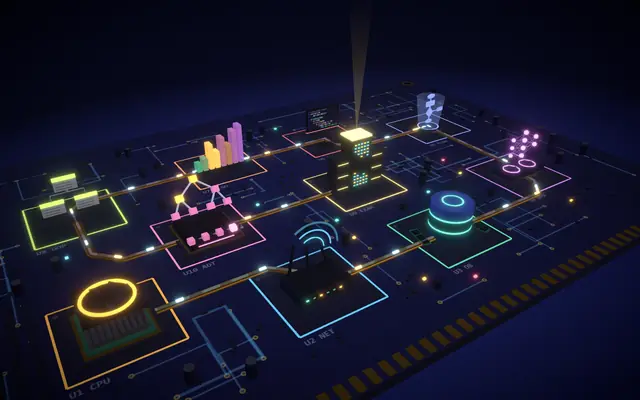
The Motherboard: the 3D map of Computer Science in 7Quest

What’s on the map

Every component of The Motherboard covers a block of the syllabus. Stages marked HL are for higher level only.

Standard levelPapers 1 and 2 plus the IA. HL‑only stages stay optional.
Higher levelEverything, including the Data Vault (abstract data types) and the HL stages of every component.
A1

Silicon Core

Computer fundamentals

  1. The heart of the CPU
  2. GPU and the memory hierarchy
  3. Pipelining and multi-core processorsHL
  4. Secondary storage and the cloud
  5. Binary and hexadecimal
  6. Everything is binary: text, images and sound
  7. Lossless and lossy compression
  8. Logic gates and truth tables
  9. Logic circuits
  10. The operating system
  11. Scheduling and interrupts
  12. Multitasking, resource allocation and deadlockHL
  13. Control systemsHL
  14. Interpreters and compilersHL
A2

Network Hub

Networks

  1. Types of network and devices
  2. The internet, the cloud and network models
  3. Protocols and the TCP/IP model
  4. Topologies, servers and segmentation
  5. IP addresses, media and packets
  6. Static and dynamic routingHL
  7. Threats, firewalls and countermeasures
  8. Encryption, signatures and certificates
A3

Deep Archive

Databases

  1. Relational databases
  2. Schemas and ER diagrams
  3. Data types and CREATE TABLE
  4. Normalisation to 3NF
  5. SQL queries and JOINs
  6. Changing data, grouping and aggregates
  7. Views and transactionsHL
  8. Alternative and distributed databasesHL
  9. Data warehouses, OLAP and data miningHL
A4

Synthetic Mind

Machine learning

  1. Types of machine learning
  2. Hardware for machine learning
  3. Preparing data for machine learningHL
  4. Linear regression and classificationHL
  5. Hyperparameters and model selectionHL
  6. Clustering and association rulesHL
  7. Reinforcement learning and genetic algorithmsHL
  8. Artificial and convolutional neural networksHL
  9. Ethics of machine learning
  10. A society that depends on machines
B1

Thinking Workshop

Computational thinking

  1. The four pillars
  2. Specifying the problem
  3. Flowcharts
B2.1, B2.3

Code Forge

Programming fundamentals

  1. Variables, data types and operators
  2. Selection: if and else
  3. Iteration: for and while
  4. Strings and substrings
  5. Functions and modularisation
  6. Errors, exceptions and debugging
B2.2, B2.4–B2.5

Algorithm Engine

Data structures, algorithms and files

  1. Lists and 2D lists
  2. Stacks and queues
  3. Big O notation
  4. Linear and binary search
  5. Bubble sort and selection sort
  6. RecursionHL
  7. File processing
B3

Object Citadel

Object-oriented programming

  1. OOP fundamentals
  2. Defining classes and instantiating objects
  3. Designing classes with UML
  4. Static and instance members
  5. Encapsulation and information hiding
  6. Inheritance and polymorphismHL
  7. Abstraction, composition and aggregationHL
  8. Design patternsHL
B4.1

Data Vault

Abstract data types (HL)

  1. Abstract data typesHL
  2. Linked listsHL
  3. Binary search treesHL
  4. Sets and hash tablesHL
Exam

The Mainframe

Exam preparation

  1. Exam technique
  2. The case study
  3. The internal assessment (IA)
  4. Mock Paper 1
  5. Mock Paper 2
  6. The Guardian of the Mainframe

How the Computer Science papers work

Computer Science has a new guide with first exams in May 2027, so there are almost no past papers for it yet. Machine learning is now part of the core, Paper 2 is about writing and reading real code, and there is no separate Paper 3 any more.

Paper 1Concepts of computer science

SL
1 h 15 · 50 marks · 35%
HL
2 h · 80 marks · 40%

What it is. Theme A: hardware, networks, databases and machine learning. Mostly structured questions where each mark is one precise term or one reason.

Practising it here. Every place in Theme A has its own exam questions with markschemes, and the SQL questions come with the tables they query. Practice tests in Paper 1 format draw from Theme A only.

Paper 2Problem solving and programming

SL
1 h 15 · 50 marks · 35%
HL
2 h · 80 marks · 40%

What it is. Theme B: computational thinking, algorithms, programming and object-oriented design. You trace code, complete it, fix it and write short methods.

Practising it here. All the code (lessons, questions, labs and practice tests) comes in Python or Java: you pick the one your school teaches and can switch at any time. There are minigames for tracing, sorting, searching and class diagrams, and practice tests in Paper 2 format draw from the Theme B places only.
Times, marks and weightings are for the current guide. The internal assessment makes up the rest of the grade.

Where marks usually go

The same few slips cost marks in almost every Computer Science paper. Each one is something the marking in 7Quest points out when you make it.

  • Answers that name a concept but do not say what it does in the scenario (“use encryption” with no mention of what is protected and from whom).
  • Off-by-one errors when tracing loops. Write the trace table instead of doing it in your head.
  • Mixing up validation and verification, or primary and secondary storage, in one-mark definitions.
  • Writing pseudocode-style answers that would not run when the question asks for code in the chosen language.

Try one

An exam-style question from the Code Forge (Programming fundamentals). Answer it on paper, then open the markscheme and mark yourself.

Trace3 marksIteration: for and while

Trace the following code and state its exact output.

for i in range(1, 4):
    line = ""
    for j in range(i):
        line = line + str(i)
    print(line)
Show the markscheme

Markscheme (3 marks)

  1. First line: 1.
  2. Second line: 22.
  3. Third line: 333 (and there are no more lines: range(1, 4) does not include 4).
  4. Trace table showing line reset to "" for each i and the inner loop running i times (j from 0 to i - 1).

A full-marks answer

One row per change of a variable or output:

i   j   line   output
1       ""
1   0   "1"
1              1
2       ""
2   0   "2"
2   1   "22"
2              22
3       ""
3   0   "3"
3   1   "33"
3   2   "333"
3              333

line is reset to "" on each iteration of the outer loop and the inner loop runs i times. Exact output, on three lines: 1, 22, 333.

Trace the following code and state its exact output.

for (int i = 1; i < 4; i++) {
    String line = "";
    for (int j = 0; j < i; j++) {
        line = line + i;
    }
    System.out.println(line);
}
Show the markscheme

Markscheme (3 marks)

  1. First line: 1.
  2. Second line: 22.
  3. Third line: 333 (and there are no more lines: i < 4 is false when i reaches 4).
  4. Trace table showing line reset to "" for each i and the inner loop running i times (j from 0 to i - 1).

A full-marks answer

One row per change of a variable or output:

i   j   line   output
1       ""
1   0   "1"
1              1
2       ""
2   0   "2"
2   1   "22"
2              22
3       ""
3   0   "3"
3   1   "33"
3   2   "333"
3              333

line is declared again as "" on each iteration of the outer loop and the inner loop runs i times. Exact output, on three lines: 1, 22, 333.

More from Programming fundamentals

What each stage has

A short lesson, a few quick questions, a minigame and one exam-style question, marked point by point against the markscheme. Whatever you miss comes back in your daily review.

Computer Science is US$39 for the first academic year, then US$49 a year (plus any tax, added at checkout), or US$63 for both DP years. Full access opens on 1 January 2027. Until then you can pick any one topic and do all of it free. See pricingFounder price: 20% off the first payment until 28 February 2027. US$49 a year from 1 March 2027.

Start Computer Science free

Questions about Computer Science

Does the order of the syllabus matter?

No. You can open any place on the map in any order and follow your class. The route on the map is only a suggestion.

Is it for SL or HL?

Both. Stages for higher level only are labelled HL, so SL students can skip them. You choose your level when you add the subject and can switch at any time in your account.

What is free?

You get one topic in each subject in full, whichever you choose, with short practice tests on it and up to 5 AI marks a day. No card is needed. A good choice is the topic you find hardest. Once you pick it, it stays your free topic for that subject.