The Collider

Physicsrevision for the IB Diploma, SL and HL

A particle accelerator whose experimental halls hold motion, matter, waves, fields and the nucleus. Lessons, minigames and exam-style questions for SL and HL, written to the subject guide first assessed in 2025.

SL and HL
11halls
60stages
16HL-only stages
2mock papers
75 hof work in total
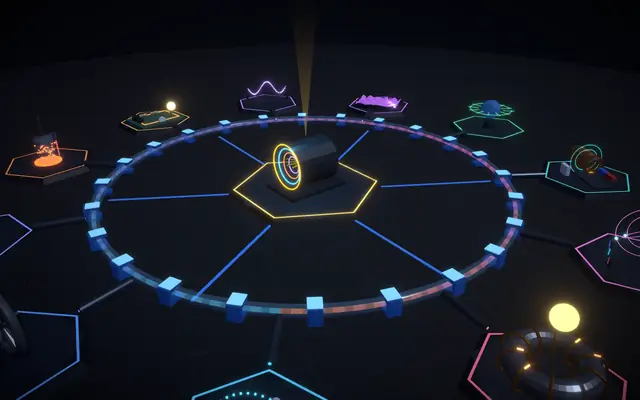
The Collider: the 3D map of Physics in 7Quest

What’s on the map

Every hall of The Collider covers a block of the syllabus. Stages marked HL are for higher level only.

Standard levelThemes A–E at standard level. HL‑only topics stay optional.
Higher levelEverything, including rigid bodies, relativity, thermodynamics, induction and quantum physics.
A.1–A.2

Launch Bay

Kinematics, forces and momentum

  1. Describing motion: displacement, velocity and acceleration
  2. Equations of motion and projectiles
  3. Measuring motion: uncertainties and graphs
  4. Newton’s laws and free-body diagrams
  5. Friction, springs, drag and buoyancy
  6. Momentum, impulse and collisions
  7. Circular motion
A.3–A.4

Flywheel Hall

Work, energy, power and rigid bodies

  1. Work and mechanical energy
  2. Energy conservation, power and efficiency
  3. Torque and rotational motionHL
  4. Moment of inertia and angular momentumHL
A.5

Light Clock

Galilean and special relativity

  1. Reference frames and the two postulatesHL
  2. Lorentz transformations, time and lengthHL
  3. Spacetime diagrams, simultaneity and muonsHL
B.1–B.4

Thermal Lab

Thermal energy, greenhouse effect, gases and thermodynamics

  1. Particles, temperature and internal energy
  2. Specific heat capacity and specific latent heat
  3. Conduction, convection and thermal radiation
  4. Energy balance and the greenhouse effect
  5. Gas laws and the kinetic model
  6. The first law and gas processesHL
  7. Heat engines, entropy and the second lawHL
B.5

Circuit Deck

Current and circuits

  1. Charge, current and potential difference
  2. Resistance, resistivity and I–V characteristics
  3. Series and parallel circuits, potential dividers and meters
  4. Emf, internal resistance and sources of energy
C.1–C.2

Oscillator Room

Simple harmonic motion and the wave model

  1. The condition for simple harmonic motion
  2. Mass–spring systems, pendulums and energy
  3. Phase, SHM equations and energyHL
  4. The wave model: travelling waves
C.3–C.5

Wave Tank

Wave phenomena, standing waves and the Doppler effect

  1. Wavefronts, refraction and total internal reflection
  2. Diffraction, superposition and double-slit interference
  3. Single-slit diffraction, multiple slits and gratingsHL
  4. Standing waves, resonance and damping
  5. The Doppler effect for sound and light
D.1

Orbit Station

Gravitational fields

  1. Newton’s law and field strength
  2. Kepler’s laws and circular orbits
  3. Gravitational potential and potential energyHL
  4. Orbital energy and escape speedHL
D.2–D.4

Magnet Hall

Electric and magnetic fields, and induction

  1. Charge, Coulomb’s law and Millikan
  2. Electric and magnetic field lines
  3. Electric potential and equipotentialsHL
  4. Magnetic forces on charges and currents
  5. Charged particles in electric and magnetic fields
  6. Electromagnetic inductionHL
E.1–E.2

Spectrometer

The structure of the atom and quantum physics

  1. Rutherford’s nucleus
  2. Energy levels and spectral lines
  3. The photoelectric effectHL
  4. Matter waves and Compton scatteringHL
E.3–E.5

Reactor Core

Radioactive decay, fission, fusion and stars

  1. Nuclei, mass defect and binding energy
  2. Alpha, beta and gamma decay
  3. Activity, half-life and background radiation
  4. The radioactive decay lawHL
  5. Fission and nuclear power
  6. Fusion and stars
Exam

Control Room

Exam preparation

  1. Paper 1: multiple choice and data-based questions
  2. Paper 2: calculations, explanations and graphs
  3. The scientific investigation (IA)
  4. Mock Paper 1
  5. Mock Paper 2
  6. Final challenge: Discovery

How the Physics papers work

Physics changed in 2025: there are no options any more, Paper 1 now has a data-based section (1B), and the old Paper 3 is gone. A lot of older practice material is still organised around options and Paper 3, so check which guide a question was written for.

Paper 11A multiple choice and 1B data-based

SL
1 h 30 · 36%
HL
2 h · 36%

What it is. Paper 1A is multiple choice (25 questions at SL, 40 at HL), mostly one-line calculations or a graph to read. Paper 1B is about experimental work: uncertainties, gradients, linearising a relationship.

Practising it here. Every stage ends with quick questions in the 1A style, and the Paper 1 mock in the Control Room is timed like the real one. Uncertainty and graph work have their own minigames.

Paper 2Short and extended response

SL
1 h 30 · 50 marks · 44%
HL
2 h 30 · 90 marks · 44%

What it is. Structured questions that start with a calculation and end with an explanation. The explanations are where the marks go missing: “the force increases” is not an answer to “explain”.

Practising it here. Written answers are marked point by point against a markscheme, and numerical answers are checked to the significant figures the question asks for, as an examiner would.
Times, marks and weightings are for the current guide. The internal assessment makes up the rest of the grade.

Where marks usually go

The same few slips cost marks in almost every Physics paper. Each one is something the marking in 7Quest points out when you make it.

  • Too many significant figures. If the data is given to 2 s.f., an answer to 6 s.f. can cost the mark.
  • A missing or wrong unit on the final answer, especially in fields (N C⁻¹ and V m⁻¹ are both fine; N C⁻² is not).
  • Sign conventions in momentum and work done on or by a gas. Write down which direction is positive before you start.
  • “Explain” answers that describe what happens without the physics that causes it.

Try one

An exam-style question from the Reactor Core (Radioactive decay, fission, fusion and stars). Answer it on paper, then open the markscheme and mark yourself.

Calculate3 marksNuclei, mass defect and binding energy

The mass of a lithium-7 nucleus (37Li{}^{7}_{3}\text{Li}) is 7.014356 u7.014356\,\text{u}. Calculate, in MeV, the binding energy per nucleon of lithium-7. (mp=1.007276 um_p = 1.007276\,\text{u}, mn=1.008665 um_n = 1.008665\,\text{u})

Show the markscheme

Markscheme (3 marks)

  1. Mass defect: Δm=3(1.007276)+4(1.008665)−7.014356=0.042132 u\Delta m = 3(1.007276) + 4(1.008665) - 7.014356 = 0.042132\,\text{u} [M1]
  2. Binding energy: 0.042132×931.5=39.2 MeV0.042132 \times 931.5 = 39.2\,\text{MeV} [M1]
  3. Per nucleon: 39.2/7=5.6 MeV39.2 / 7 = 5.6\,\text{MeV} [A1] (allow ECF from an incorrect mass defect)

A full-marks answer

Lithium-7 has 3 protons and 7−3=47 - 3 = 4 neutrons.

Δm=3(1.007276)+4(1.008665)−7.014356=3.021828+4.034660−7.014356=0.042132 u\Delta m = 3(1.007276) + 4(1.008665) - 7.014356 = 3.021828 + 4.034660 - 7.014356 = 0.042132\,\text{u}

Eb=0.042132×931.5=39.2 MeVE_b = 0.042132 \times 931.5 = 39.2\,\text{MeV}

Eb/A=39.2/7=5.61 MeVE_b/A = 39.2 / 7 = 5.61\,\text{MeV} per nucleon.

More from Radioactive decay, fission, fusion and stars

What each stage has

A short lesson, a few quick questions, a minigame and one exam-style question, marked point by point against the markscheme. Whatever you miss comes back in your daily review.

Physics is US$39 for the first academic year, then US$49 a year (plus any tax, added at checkout), or US$63 for both DP years. Full access opens on 1 January 2027. Until then you can pick any one topic and do all of it free. See pricingFounder price: 20% off the first payment until 28 February 2027. US$49 a year from 1 March 2027.

Start Physics free

Questions about Physics

Does the order of the syllabus matter?

No. You can open any place on the map in any order and follow your class. The route on the map is only a suggestion.

Is it for SL or HL?

Both. Stages for higher level only are labelled HL, so SL students can skip them. You choose your level when you add the subject and can switch at any time in your account.

What is free?

You get one topic in each subject in full, whichever you choose, with short practice tests on it and up to 5 AI marks a day. No card is needed. A good choice is the topic you find hardest. Once you pick it, it stays your free topic for that subject.