Spectral Lamp
Particles, atoms and electrons
- Elements, compounds, mixtures and the states of matter
- The nuclear atom and isotopes
- Emission spectra and energy levels
- Electron configurations
- Ionization energies: evidence for electron structureHL
A laboratory with two benches: Structure on one side, Reactivity on the other, and the Crucible waiting at the end. Lessons, minigames and exam-style questions for SL and HL, written to the subject guide first assessed in 2025.
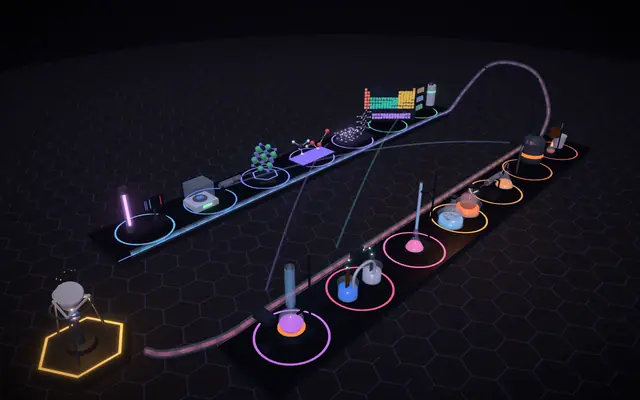
Every station of The Lab covers a block of the syllabus. Stages marked HL are for higher level only.
Particles, atoms and electrons
The mole and ideal gases
The ionic model
The covalent model
Metallic bonding and materials
The periodic table
Organic compounds and spectroscopy
Energetics: enthalpy, fuels and spontaneity
Amounts of chemical change
Rates of reaction
Chemical equilibrium
Acids and bases
Redox and electrochemistry
Radicals, nucleophiles and electrophiles
Exam preparation
The 2025 Chemistry guide is organised as Structure 1–3 and Reactivity 1–3 instead of numbered topics, and the codes (S1.1, R2.2…) are what teachers and textbooks now use. The map follows the same order, so S1.4 in your syllabus is S1.4 here.
What it is. Paper 1A is multiple choice (30 questions at SL, 40 at HL). Paper 1B gives you a practical or a data set to work with: processing results, uncertainties and evaluating a method.
Practising it here. Each stage has quick questions in the 1A style. Titration, calorimetry and rate data turn up as tables you actually have to process, and the Crucible holds a timed Paper 1 mock.
What it is. Structured questions across the whole syllabus. Expect to draw structures and mechanisms, balance equations with state symbols and explain trends with the right particle-level reason.
Practising it here. Mechanisms, molecular shapes and titrations have their own minigames, and equations are balanced in the app and checked by the coefficients. Written explanations are marked point by point.
Times, marks and weightings are for the current guide. The internal assessment makes up the rest of the grade.
The same few slips cost marks in almost every Chemistry paper. Each one is something the marking in 7Quest points out when you make it.
An exam-style question from the Pilot Reactor (Amounts of chemical change). Answer it on paper, then open the markscheme and mark yourself.
In a blast furnace, iron is made by reducing iron(III) oxide with carbon monoxide: .
(a) Calculate the percentage atom economy for the production of iron. Use sections 1 and 7 of the data booklet. [1]
(b) In one batch, of iron(III) oxide produced of iron, the other reactants being in excess. Calculate the percentage yield. [2]
(c) Some new steel plants reduce iron(III) oxide with hydrogen instead: . Calculate the percentage atom economy of this method. [1]
(d) Comment on which of the two methods is preferable from a green chemistry perspective. [1]
Markscheme (5 marks)
A full-marks answer
(a) The molar masses with their coefficients: desired product , all reactants . Atom economy .
(b) Theoretical yield , so the percentage yield is .
(c) Desired product , all reactants : atom economy .
(d) The hydrogen method is greener: its atom economy is higher (67.4 % against 45.8 %), so less of the mass of the reactants is wasted, and its by-product is water instead of carbon dioxide, a greenhouse gas. It is only truly green if the hydrogen is made without fossil fuels, for example by electrolysis using renewable electricity.
Each topic page lists what the stages cover and has two exam-style questions with their markschemes.
Ideas that come up in question after question, each worked through on its own page with original questions and markschemes to mark yourself against.
A short lesson, a few quick questions, a minigame and one exam-style question, marked point by point against the markscheme. Whatever you miss comes back in your daily review.
Chemistry is US$39 for the first academic year, then US$49 a year (plus any tax, added at checkout), or US$63 for both DP years. Full access opens on 1 January 2027. Until then you can pick any one topic and do all of it free. See pricingFounder price: 20% off the first payment until 28 February 2027. US$49 a year from 1 March 2027.
Start Chemistry freeNo. You can open any place on the map in any order and follow your class. The route on the map is only a suggestion.
Both. Stages for higher level only are labelled HL, so SL students can skip them. You choose your level when you add the subject and can switch at any time in your account.
You get one topic in each subject in full, whichever you choose, with short practice tests on it and up to 5 AI marks a day. No card is needed. A good choice is the topic you find hardest. Once you pick it, it stays your free topic for that subject.