The Agora
Introduction to economics
- Scarcity, choice and the PPC
- Economic systems and the circular flow
- How economists approach the world
A harbour city of markets, policy, trade and development. Lessons, minigames and exam-style questions for SL and HL, written to the subject guide first assessed in 2022.
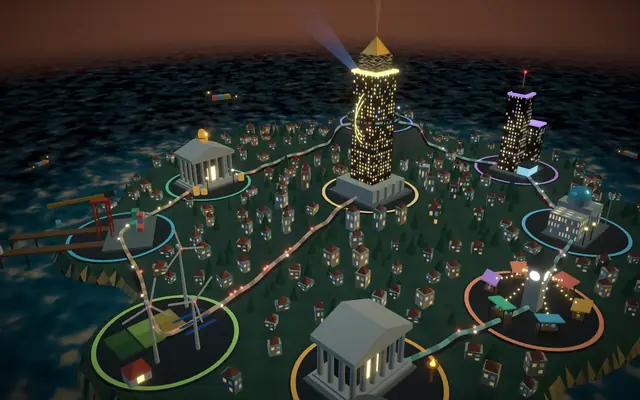
Every district of The Island covers a block of the syllabus. Stages marked HL are for higher level only.
Introduction to economics
Microeconomics: competitive markets
Microeconomics: government and market failure
Microeconomics: information, market power and equity (HL)
Macroeconomics: measuring and modelling the economy
Macroeconomics: inequality and policy
The global economy: trade and exchange rates
The global economy: development
Assessment: papers, IA and mocks
Economics is the subject where you can know everything and still drop marks, because each paper wants a different kind of answer. Paper 1 is a diagram and an argument, Paper 2 is reading data quickly, and Paper 3 is arithmetic followed by a policy you have to defend.
What it is. You pick one question from a choice and answer both parts: a 10-mark explanation, then a 15-mark evaluation. Both are marked in bands, so a correct diagram that you never refer to in the text barely counts.
Practising it here. The essay stages ask a two-part question in the exam format and the AI marks it against the band descriptors. The Paper 1 mock at the Exchange gives you a choice of questions and a 1 h 15 clock.
What it is. You answer one of two questions. Each is a text and a table or chart about a real economy, then short parts (define, calculate, draw) and a 15-mark part at the end that has to use the text. Most people lose time, not knowledge, on this paper.
Practising it here. Data questions with real figures sit in every place on the map. Practice tests in Paper 2 format mix short questions and a longer case, and the calculations come back with new numbers.
What it is. Calculations from a data pack (elasticities, multipliers, tariffs, Gini, exchange rates) and a 10-mark policy recommendation. Show every line of working: a correct method usually earns a mark even when the final answer is wrong.
Practising it here. Most calculation questions come back with new numbers, so you can redo the same type until it is automatic. The HL mock at the Exchange ends with the recommendation.
Times, marks and weightings are for the current guide. The internal assessment makes up the rest of the grade.
The same few slips cost marks in almost every Economics paper. Each one is something the marking in 7Quest points out when you make it.
An exam-style question from the Market Square (Microeconomics: competitive markets). Answer it on paper, then open the markscheme and mark yourself.
Average household income in a country rises from £32,000 to £34,400 and the number of restaurant meals bought rises from 50 million to 58 million a year. Calculate the YED for restaurant meals and state what it indicates about the good.
Markscheme (3 marks)
A full-marks answer
The percentage change in income is and the percentage change in quantity demanded is . So . Because YED is positive, restaurant meals are a normal good; because it is greater than 1, demand is income elastic — typical of a luxury or service.
Each topic page lists what the stages cover and has two exam-style questions with their markschemes.
Ideas that come up in question after question, each worked through on its own page with original questions and markschemes to mark yourself against.
A short lesson, a few quick questions, a minigame and one exam-style question, marked point by point against the markscheme. Whatever you miss comes back in your daily review.
Economics is US$39 for the first academic year, then US$49 a year (plus any tax, added at checkout), or US$63 for both DP years. Full access opens on 1 January 2027. Until then you can pick any one topic and do all of it free. See pricingFounder price: 20% off the first payment until 28 February 2027. US$49 a year from 1 March 2027.
Start Economics freeNo. You can open any place on the map in any order and follow your class. The route on the map is only a suggestion.
Both. Stages for higher level only are labelled HL, so SL students can skip them. You choose your level when you add the subject and can switch at any time in your account.
You get one topic in each subject in full, whichever you choose, with short practice tests on it and up to 5 AI marks a day. No card is needed. A good choice is the topic you find hardest. Once you pick it, it stays your free topic for that subject.