The Living Plate

Biologyrevision for the IB Diploma, SL and HL

A culture plate whose wells hold life from molecules to ecosystems. Lessons, minigames and exam-style questions for SL and HL, written to the subject guide first assessed in 2025.

SL and HL
14wells
101stages
35HL-only stages
2mock papers
80 hof work in total
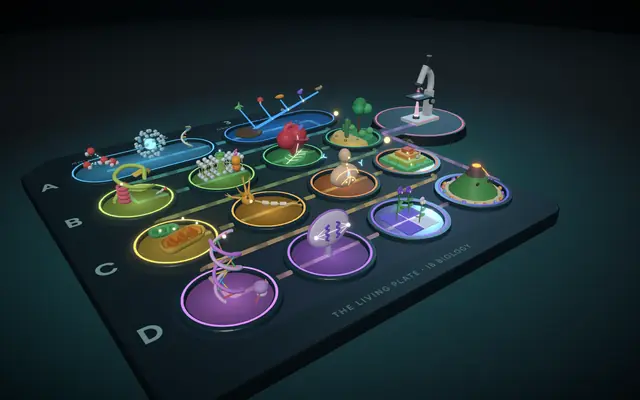
The Living Plate: the 3D map of Biology in 7Quest

What’s on the map

Every well of The Living Plate covers a block of the syllabus. Stages marked HL are for higher level only.

Standard levelThemes A–D at standard level. HL‑only topics stay optional.
Higher levelEverything, including origins of cells, viruses, cladistics, muscle, chemical signalling and gene expression.
A1.1–A2.3

Primordial Pool

Water, nucleic acids, cells and viruses

  1. Water: the medium for life
  2. Nucleic acids: DNA and RNA
  3. Water beyond Earth and the evidence for DNAHL
  4. Cells: prokaryotes, eukaryotes and the exceptions
  5. Microscopy: magnification, measurement and micrographs
  6. The data toolkit: variables, uncertainty and statistics
  7. The origin of cells and of eukaryotesHL
  8. Viruses: structure, cycles and rapid evolutionHL
A3.1–A4.2

Tree of Life

Diversity, classification, evolution and conservation

  1. Species: variation, names and boundaries
  2. Chromosomes, karyograms and genomes
  3. Species limits, dichotomous keys and DNA barcodesHL
  4. Classification and cladisticsHL
  5. Evolution and the evidence for it
  6. Speciation: how new species form
  7. Biodiversity and the sixth mass extinction
B1.1–B1.2

Molecule Forge

Carbohydrates, lipids and proteins

  1. Carbon compounds and carbohydrates
  2. Lipids: fats, oils, phospholipids and steroids
  3. Amino acids, polypeptides and denaturation
  4. Protein structure: from sequence to shapeHL
B2.1–B2.3

Membrane Gate

Membranes, organelles and cell specialization

  1. Membranes and membrane transport
  2. Membrane fluidity, vesicles and transportersHL
  3. Organelles and compartmentalization
  4. Adaptations of organellesHL
  5. Stem cells, differentiation and cell size
  6. Adaptations of specialized cellsHL
B3.1–B3.3

Heart Chamber

Gas exchange, transport, muscle and motility

  1. Gas exchange in the lungs and ventilation
  2. Gas exchange in leaves and transpiration
  3. Haemoglobin and oxygen transportHL
  4. Blood vessels, the pulse and coronary heart disease
  5. Transport in plants
  6. Tissue fluid, circulation and the heartHL
  7. Muscle and motilityHL
B4.1–B4.2

Biome Terrace

Adaptation to environment and ecological niches

  1. Habitats, adaptations and tolerance
  2. Biomes: climate, communities and adaptations
  3. Niches and modes of nutrition
  4. Feeding, light and competition
C1.1–C1.3

The Powerhouse

Enzymes, cell respiration and photosynthesis

  1. Enzymes and metabolism
  2. Rates of enzyme activity
  3. Regulation of metabolismHL
  4. ATP and cell respiration
  5. Glycolysis and anaerobic respirationHL
  6. The Krebs cycle and chemiosmosisHL
  7. Photosynthesis and its limiting factors
  8. The light-dependent reactionsHL
  9. The Calvin cycleHL
C2.1–C2.2

Synapse Junction

Chemical and neural signalling

  1. Neurons and nerve impulses
  2. Synapses
  3. Action potentials and their propagationHL
  4. Synaptic integration, pain and consciousnessHL
  5. Signalling chemicals and their receptorsHL
  6. Signal transduction pathwaysHL
C3.1–C3.2

Body Command

Integration of body systems and defence against disease

  1. Integrating body systems: nerves, hormones and blood
  2. Reflexes, the cerebellum and hormones
  3. Feedback control: heart rate, breathing and the gut
  4. Plant responses: tropisms and phytohormonesHL
  5. Pathogens and the first lines of defence
  6. Lymphocytes, antibodies and immunity
  7. Antibiotics, zoonoses and vaccines
C4.1–C4.2

Food Web Meadow

Populations, communities, energy and matter

  1. Estimating population size
  2. Carrying capacity and population growth
  3. Interactions in communities
  4. Energy into ecosystems: food chains and nutrition
  5. Trophic levels, energy pyramids and production
  6. The carbon cycle
D1.1–D1.3

Double Helix

DNA replication, protein synthesis and mutation

  1. DNA replication, PCR and gel electrophoresis
  2. The replication fork: leading strand, lagging strand and proofreadingHL
  3. Transcription and translation
  4. The genetic code and how the ribosome reads it
  5. From promoter to protein: processing genes and polypeptidesHL
  6. Gene mutations: types, causes and consequences
  7. Gene knockout, CRISPR–Cas9 and conserved sequencesHL
D2.1–D2.3

The Spindle

Cell division, gene expression and water potential

  1. Cell division and mitosis
  2. Meiosis and variation
  3. The cell cycle, cyclins and cancerHL
  4. Gene expression and its regulationHL
  5. Epigenetics and the environmentHL
  6. Osmosis in cells and tissues
  7. Water potentialHL
D3.1–D3.3

Mendel’s Garden

Reproduction, inheritance and homeostasis

  1. Sexual reproduction in humans
  2. Sexual reproduction in flowering plants
  3. Puberty, gametes, pregnancy and birthHL
  4. Mendelian genetics: alleles, crosses and PKU
  5. Multiple alleles, sex linkage and pedigrees
  6. Dihybrid crosses, linkage and the chi-squared testHL
  7. Homeostasis: blood glucose and body temperature
  8. The kidney: excretion and osmoregulationHL
D4.1–D4.3

Galápagos Shore

Natural selection, stability and climate change

  1. Natural selection
  2. Gene pools and the Hardy–Weinberg equationHL
  3. Ecosystem stability and sustainable harvesting
  4. Agriculture, pollution and rewilding
  5. Ecological successionHL
  6. Climate change and ecosystems
  7. Phenology and evolution in a changing climateHL
Exam

The Microscope

Exam preparation

  1. Paper 1A: multiple-choice technique
  2. Paper 1B: data-based questions
  3. Paper 2 Section A: short answers, drawings and command terms
  4. Paper 2 Section B: extended-response questions
  5. The scientific investigation (IA)
  6. Mock Paper 1: multiple-choice and data-based questions
  7. Mock Paper 2: data, short answer and extended response
  8. Final challenge: Peer review

How the Biology papers work

Biology in the 2025 guide is built around themes (A to D) and levels of organisation rather than the old topics, and it asks for more data handling than before. Learning the content is only half of it; the other half is making sense of an unfamiliar graph in a couple of minutes.

Paper 11A multiple choice and 1B data-based

SL
1 h 30 · 36%
HL
2 h · 36%

What it is. Paper 1A is multiple choice (30 questions at SL, 40 at HL). Paper 1B is data-based questions about experiments: what the data shows, what limits the conclusion, what you would change.

Practising it here. Data questions are written around real-looking experiments with their own figures, and the Microscope has a Paper 1 mock timed for your level.

Paper 2Data, short answer and extended response

SL
1 h 30 · 50 marks · 44%
HL
2 h 30 · 80 marks · 44%

What it is. A data question, short-answer questions and extended responses where you choose which to answer (one at SL, two at HL). Extended responses are marked for the number of correct, relevant points, so structure matters more than style.

Practising it here. Extended responses are marked against the full list of acceptable points, and in the mock you choose which ones to answer, as in the exam.
Times, marks and weightings are for the current guide. The internal assessment makes up the rest of the grade.

Where marks usually go

The same few slips cost marks in almost every Biology paper. Each one is something the marking in 7Quest points out when you make it.

  • Describing a graph without numbers. “It increases” earns less than “it rises from 2 to 14 units between day 3 and day 9”.
  • Mixing up “describe” and “explain”: one wants the pattern, the other wants the biological reason for it.
  • Answering a 7-mark extended response with three long points instead of seven short, correct ones.
  • Loose words that markschemes reject: “energy is made”, “the enzyme is killed”.

Try one

An exam-style question from the The Powerhouse (Enzymes, cell respiration and photosynthesis). Answer it on paper, then open the markscheme and mark yourself.

Explain4 marksRates of enzyme activity

Explain the effect of increasing the substrate concentration on the rate of an enzyme-catalysed reaction, when the amount of enzyme is fixed. [4]

Show the markscheme

Markscheme (4 marks)

  1. [max 4] a. At low substrate concentration, rate increases (steeply / in proportion) as concentration increases ;
  2. b. More frequent collisions between substrate and active sites ;
  3. c. At high concentration the rate levels off / reaches a maximum (plateau) ;
  4. d. Active sites are (nearly) all occupied / enzyme is saturated ;
  5. e. Enzyme concentration becomes the limiting factor / extra substrate cannot find free active sites ;

A full-marks answer

At low substrate concentrations the rate rises steeply, almost in proportion to the concentration, because more substrate molecules means more frequent collisions with the many free active sites. As the concentration increases further, the rise becomes smaller and the rate levels off at a maximum. At this point almost all the active sites are occupied at any moment: the enzyme is saturated, so the amount of enzyme, not the substrate, limits the rate.

More from Enzymes, cell respiration and photosynthesis

What each stage has

A short lesson, a few quick questions, a minigame and one exam-style question, marked point by point against the markscheme. Whatever you miss comes back in your daily review.

Biology is US$39 for the first academic year, then US$49 a year (plus any tax, added at checkout), or US$63 for both DP years. Full access opens on 1 January 2027. Until then you can pick any one topic and do all of it free. See pricingFounder price: 20% off the first payment until 28 February 2027. US$49 a year from 1 March 2027.

Start Biology free

Questions about Biology

Does the order of the syllabus matter?

No. You can open any place on the map in any order and follow your class. The route on the map is only a suggestion.

Is it for SL or HL?

Both. Stages for higher level only are labelled HL, so SL students can skip them. You choose your level when you add the subject and can switch at any time in your account.

What is free?

You get one topic in each subject in full, whichever you choose, with short practice tests on it and up to 5 AI marks a day. No card is needed. A good choice is the topic you find hardest. Once you pick it, it stays your free topic for that subject.