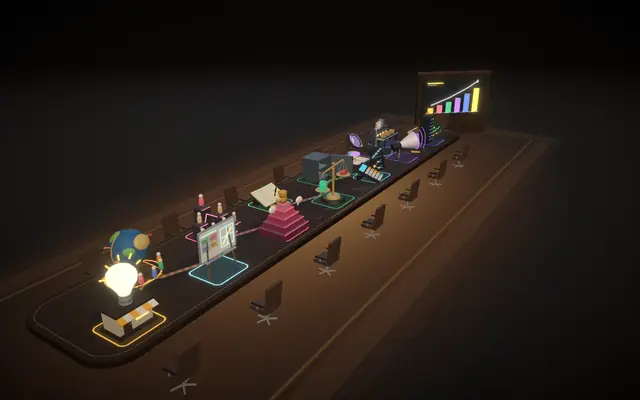
The Boardroom Table

Business Managementrevision for the IB Diploma, SL and HL

A seat at the board table for every decision a business makes. Lessons, minigames and exam-style questions for SL and HL, written to the subject guide first assessed in 2024.

SL and HL
13seats
84stages
28HL-only stages
3mock papers
103 hof work in total
The Boardroom Table: the 3D map of Business Management in 7Quest

What’s on the map

Every seat of The Boardroom Table covers a block of the syllabus. Stages marked HL are for higher level only.

Standard levelUnits 1–5 and the core toolkit at standard level. HL‑only topics stay optional.
Higher levelEverything, including culture, employee relations, efficiency ratios, NPV, budgets, lean production, production planning, R&D, information systems, Paper 3 and the HL tools.
1.1–1.3

The Launchpad

What is a business? Entities and objectives

  1. What businesses do and the four sectors
  2. Starting up: entrepreneurs, opportunities and challenges
  3. Private and public sectors; sole traders, partnerships and companies
  4. Social enterprises: cooperatives, public sector companies and NGOs
  5. Vision, mission and business objectives
  6. Corporate social responsibility (CSR)
1.4–1.6

Stakeholder Globe

Stakeholders, growth and multinationals

  1. Stakeholders and their conflicts
  2. Economies of scale: grow or stay small?
  3. External growth: M&As, joint ventures, alliances and franchising
  4. Multinationals and their host countries
Toolkit

The Strategy Wall

Toolkit: strategic analysis

  1. The business plan
  2. SWOT and STEEPLE analysis
  3. The Ansoff matrix
  4. Circular business models
  5. Porter’s generic strategiesHL
  6. Force field analysisHL
  7. Hofstede’s cultural dimensionsHL
2.1–2.3

The Org Chart

HRM, organizational structure and leadership

  1. The role of HRM and workforce planning
  2. Change and resistance to change
  3. Organizational structure and organization charts
  4. Management and leadership styles
2.4–2.7

Motivation Pyramid

Motivation, culture, communication and employee relations

  1. Motivation theories: Taylor, Maslow and Herzberg
  2. McClelland, Deci and Ryan, equity and expectancyHL
  3. Rewards and training
  4. Labour turnover, recruitment and appraisalHL
  5. Communication: methods and barriers
  6. Organizational culture and culture clashesHL
  7. Industrial and employee relationsHL
3.1–3.4

The Ledger

Finance, costs and final accounts

  1. The role of finance and internal sources
  2. External sources of finance
  3. Costs and revenues
  4. Final accounts: the statement of profit or loss
  5. Final accounts: the statement of financial position
  6. DepreciationHL
3.5–3.6

Ratio Scales

Ratio analysis

  1. Profitability ratios: margins and ROCE
  2. Liquidity ratios: current ratio and acid test
  3. Efficiency ratios: stock, debtors and creditorsHL
  4. Gearing, insolvency and bankruptcyHL
3.7–3.9

The Vault

Cash flow, investment appraisal and budgets

  1. Profit versus cash flow
  2. Cash-flow forecasts and cash-flow problems
  3. Investment appraisal: payback and ARR
  4. Net present valueHL
  5. Budgets, cost centres and variancesHL
Toolkit

The Analyst's Desk

Toolkit: quantitative decision tools

  1. Decision trees: expected values and choices
  2. Descriptive statistics: averages, spread and charts
  3. Simple linear regression: scatter diagrams and forecastsHL
  4. Contribution: costing methods and make-or-buyHL
  5. Gantt charts: planning a project in timeHL
  6. Critical path analysis: networks, floats and controlHL
4.1–4.4

Market Lens

Marketing planning and market research

  1. Market orientation, market share and market growth
  2. Marketing planning, segmentation and target markets
  3. Positioning, position maps and the USP
  4. Sales forecastingHL
  5. Market research: why and how
  6. Sampling: quota, random and convenience
4.5–4.6

Brand Studio

The marketing mix and international marketing

  1. The product life cycle, extension strategies and the BCG matrix
  2. Branding
  3. Pricing methods
  4. Dynamic, competitive and contribution pricing, and price elasticity of demandHL
  5. Promotion: above, below and through the line, and social media marketing
  6. Place, and people, processes and physical evidence in services
  7. Appropriate marketing mixes
  8. International marketingHL
5.1–5.5

Production Line

Operations methods, location and break-even

  1. Operations management and operations methods
  2. Lean production and quality managementHL
  3. Location and reorganizing production
  4. Break-even analysis
  5. Break-even: targets, changes and limitations
5.6–5.9

The Control Room

Production planning, crisis, R&D and information systems (HL)

  1. Supply chains, JIT, JIC and stock controlHL
  2. Capacity, quality and productivityHL
  3. Crisis management and contingency planningHL
  4. Research and development, intellectual property and innovationHL
  5. Management information systems and new technologiesHL
  6. Loyalty programmes, data mining, digital Taylorism and ethicsHL
Exam

Head of the Table

Exam preparation

  1. Paper 1: reading the case and Section A
  2. The pre-released statement: five hours of research
  3. Section B: writing a 10-mark answer
  4. Paper 2: calculations, constructions and the formulae sheet
  5. Paper 3: the social enterprise paperHL
  6. The business research project (IA)
  7. Mock Paper 1: Greenrise Farms
  8. Mock Paper 2: five businesses, one formulae sheet
  9. Mock Paper 3: TapwiseHL
  10. Final challenge: the board vote

How the Business Management papers work

Business Management rewards applying the theory to the business in front of you. The 2024 guide made the business management toolkit (SWOT, decision trees, Ansoff, force field analysis…) a named part of the course and added a social-enterprise Paper 3 at HL. Generic answers that could be about any company score poorly in both.

Paper 1Pre-released case study

SL
1 h 30 · 30 marks · 35%
HL
1 h 30 · 30 marks · 25%

What it is. The case context is released before the exam and extra information comes on the day. Questions build to a 10-mark answer where you weigh options and reach a decision.

Practising it here. Case questions highlight the lines of the case they refer to, so you get used to quoting it. The Paper 1 mock at Head of the Table is timed at 1 h 30.

Paper 2Quantitative questions

SL
1 h 30 · 40 marks · 35%
HL
1 h 45 · 50 marks · 30%

What it is. Final accounts, ratios, break-even, investment appraisal and cash flow, each followed by written analysis. A correct number with no comment about what it means is half an answer.

Practising it here. Financial statements are laid out as in the exam, and the calculation questions come back with new figures so you can practise the method, not the answer.

Paper 3Social enterprise (HL)

SL
Not taken at this level
HL
1 h 15 · 25 marks · 25%

What it is. An unseen case about a social enterprise. You identify its challenges, and the final question is the 17-mark recommendation on a decision it has to make, using the case and the toolkit.

Practising it here. Head of the Table has a timed Paper 3 mock built around a social enterprise, ending with the recommendation.

Times, marks and weightings are for the current guide. The internal assessment makes up the rest of the grade.

Where marks usually go

The same few slips cost marks in almost every Business Management paper. Each one is something the marking in 7Quest points out when you make it.

  • Points that never name the business. If the sentence would be true of any company, it is not application.
  • A recommendation that sits on the fence. The final question wants a decision and the reason it beats the alternative.
  • Ratios without the formula or the units, or a current ratio written as a percentage.
  • Using a toolkit item (SWOT, STEEPLE) as a list instead of using it to support a decision.

Try one

An exam-style question from the The Launchpad (What is a business? Entities and objectives). Answer it on paper, then open the markscheme and mark yourself.

Explain4 marksWhat businesses do and the four sectors

Loomhall (LH) has made wooden furniture in a factory in Country X since 1975. Country X’s secondary sector has been shrinking for 20 years, while its tertiary and quaternary sectors have grown. Many of LH’s former customers now buy cheaper imported furniture online.

Explain one opportunity and one threat for LH arising from the sectoral change in Country X.

Show the markscheme

Markscheme (4 marks)

  1. Opportunity identified, e.g. growing demand for services / higher incomes in service jobs / a more skilled workforce / new digital sales channels [1].
  2. Opportunity explained and applied to LH, e.g. LH could add a design-and-fitting service or sell made-to-order furniture online to customers working in growing service industries [1].
  3. Threat identified, e.g. falling demand for local manufacturing / competition from cheaper imports / loss of skilled factory workers [1].
  4. Threat explained and applied to LH, e.g. LH’s customers are already switching to cheaper imported furniture bought online, so its sales and profit may fall and its factory may become unviable [1].
  5. Mark as 2 + 2. A point without application to LH earns at most [1] of each pair.

A full-marks answer

One opportunity is that the growth of the tertiary and quaternary sectors means more people work in well-paid service and knowledge jobs and are used to buying services. LH could use its 50 years of craft skills to offer a design-and-fitting service or made-to-order pieces sold online, which compete on quality and personal service rather than on price with imported furniture.

One threat is that LH is a secondary-sector manufacturer in a country where manufacturing is in long-term decline. Its customers are already buying cheaper imported furniture online, so LH’s sales and profit may fall, and as fewer people train for factory work it may struggle to replace skilled employees when they retire.

More from What is a business? Entities and objectives

What each stage has

A short lesson, a few quick questions, a minigame and one exam-style question, marked point by point against the markscheme. Whatever you miss comes back in your daily review.

Business Management is US$39 for the first academic year, then US$49 a year (plus any tax, added at checkout), or US$63 for both DP years. Full access opens on 1 January 2027. Until then you can pick any one topic and do all of it free. See pricingFounder price: 20% off the first payment until 28 February 2027. US$49 a year from 1 March 2027.

Start Business Management free

Questions about Business Management

Does the order of the syllabus matter?

No. You can open any place on the map in any order and follow your class. The route on the map is only a suggestion.

Is it for SL or HL?

Both. Stages for higher level only are labelled HL, so SL students can skip them. You choose your level when you add the subject and can switch at any time in your account.

What is free?

You get one topic in each subject in full, whichever you choose, with short practice tests on it and up to 5 AI marks a day. No card is needed. A good choice is the topic you find hardest. Once you pick it, it stays your free topic for that subject.