The Graph

Mathematics: analysis and approachesrevision for the IB Diploma, SL and HL

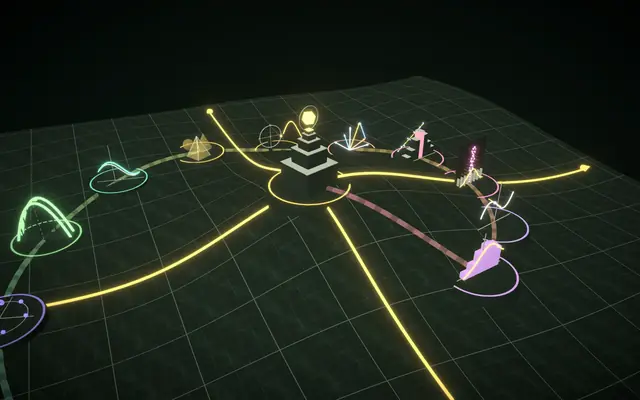
A landscape drawn by a function, with monuments to algebra, functions, geometry, statistics and calculus. Lessons, minigames and exam-style questions for SL and HL, written to the subject guide first assessed in 2021.
SL and HL
13landmarks
77stages
29HL-only stages
3mock papers
95 hof work in total
The Graph: the 3D map of Mathematics: analysis and approaches in 7Quest

What’s on the map

Every landmark of The Graph covers a block of the syllabus. Stages marked HL are for higher level only.

Standard levelPapers 1 and 2 plus the exploration. Additional HL content stays optional.
Higher levelEverything, including complex numbers, vectors, advanced calculus and Paper 3.
1.1–1.4, 1.8

The Staircase

Sequences, series and financial maths

  1. Scientific notation and arithmetic sequences
  2. Arithmetic series and sigma notation
  3. Geometric sequences, series and the sum to infinity
  4. Financial maths: compound interest and depreciation
1.5, 1.7

Log Tower

Exponents and logarithms

  1. Laws of exponents
  2. Logarithms: base 10 and base e
  3. Laws of logarithms and change of base
  4. Solving exponential equations
1.6, 1.9–1.11, 1.15–1.16

Pascal’s Pyramid

Proof, the binomial theorem and algebra

  1. Deductive proof: from LHS to RHS
  2. The binomial theorem and Pascal’s triangle
  3. Counting: permutations and combinationsHL
  4. Extended binomial theorem and partial fractionsHL
  5. Proof by mathematical inductionHL
  6. Proof by contradiction and counterexampleHL
  7. Systems of linear equationsHL
1.12–1.14

Argand Plaza

Complex numbers

  1. The complex plane: Cartesian form, modulus and argumentHL
  2. Polar and Euler forms: multiplying is rotatingHL
  3. De Moivre's theorem: powers and identitiesHL
  4. Complex roots: conjugate pairs, nth roots and roots of unityHL
2.1–2.7

Parabola Bridge

Functions, graphs and quadratics

  1. Straight lines, gradients, parallel and perpendicular
  2. Functions, domain, range and key features of graphs
  3. Quadratic functions: three forms of the parabola
  4. Quadratic equations, the discriminant and inequalities
  5. Composite and inverse functions
2.8–2.16

Transformation Gallery

Transformations and families of functions

  1. Translations, reflections and stretches
  2. Reciprocal and rational functions
  3. Exponential and logarithmic graphs
  4. Polynomials: factors, roots and inequalitiesHL
  5. Rational functions, oblique asymptotes and inversesHL
  6. Symmetry, modulus and reciprocal graphsHL
3.1–3.3

Solids Garden

Geometry and triangle trigonometry

  1. Distance, midpoint and solids
  2. Right-angled trigonometry and angles in 3D
  3. Sine rule, cosine rule and area
  4. Elevation, depression and bearings
3.4–3.11

Unit Wheel

Circular functions and trigonometric equations

  1. Radians, arcs, sectors and the unit circle
  2. Identities and the ambiguous case
  3. Graphs of the circular functions
  4. Solving trigonometric equations
  5. Reciprocal and inverse trigonometric functionsHL
  6. Compound angles and symmetryHL
3.12–3.18

Vector Observatory

Vectors, lines and planes

  1. Vectors, components and position vectorsHL
  2. The scalar product and anglesHL
  3. Lines in space: equations, angles and meeting pointsHL
  4. The vector product and equations of planesHL
  5. Intersections and angles of lines and planesHL
4.1–4.4, 4.10

Data Towers

Statistics and regression

  1. Populations, samples and data
  2. Histograms and cumulative frequency
  3. Averages, spread and box plots
  4. Correlation and regression lines
4.5–4.9, 4.11–4.14

Galton Board

Probability and distributions

  1. Sample spaces, events and Venn diagrams
  2. Conditional probability, independence and tree diagrams
  3. Discrete random variables and expected value
  4. The binomial distribution
  5. The normal distribution
  6. Bayes’ theorem, variance and linear transformationsHL
  7. Continuous random variablesHL
5.1–5.4, 5.6–5.9, 5.12–5.14

Tangent Ridge

Differentiation

  1. Limits and the gradient function
  2. Standard derivatives and the chain, product and quotient rules
  3. Tangents, normals and the second derivative
  4. Stationary points, optimisation and kinematics
  5. Continuity, first principles and l'Hôpital's ruleHL
  6. Implicit differentiation, related rates and optimisationHL
5.5, 5.10–5.11, 5.15–5.19

Area Terraces

Integration and differential equations

  1. Anti-differentiation and the area under a curve
  2. Standard integrals and the reverse chain rule
  3. Definite integrals, areas and motion
  4. Further derivatives, standard integrals and partial fractionsHL
  5. Substitution, integration by parts and volumes of revolutionHL
  6. First-order differential equationsHL
  7. Maclaurin seriesHL
Exam

The Summit

Exam preparation

  1. Paper 1: exact answers without a calculator
  2. Paper 2: using the GDC and showing it
  3. Paper 3: extended problem solvingHL
  4. The mathematical exploration (IA)
  5. Mock Paper 1
  6. Mock Paper 2
  7. Mock Paper 3HL
  8. The final challenge

How the Mathematics AA papers work

Analysis and approaches is about algebra and proof more than about the calculator. Paper 1 has no GDC at all, so if you have been leaning on it all year, that is the paper to start with.

Paper 1No calculator

SL
1 h 30 · 80 marks · 40%
HL
2 h · 110 marks · 30%

What it is. Section A is short questions, section B is a few long ones where each part builds on the last. Answers should be exact: surds, fractions and multiples of π.

Practising it here. The Summit has a timed Paper 1 mock with no calculator. Fractions such as 2/3 are accepted as typed, so you can answer the way you would on paper.

Paper 2Calculator

SL
1 h 30 · 80 marks · 40%
HL
2 h · 110 marks · 30%

What it is. Same structure with a GDC. Final answers to 3 significant figures unless the question says otherwise, and that rule is enforced.

Practising it here. Answers are accepted exact or to 3 s.f., as in the markscheme. Practice tests in Paper 2 format mix short questions and longer problems, and many come back with new numbers, so you cannot just remember the answer.

Paper 3Problem solving (HL)

SL
Not taken at this level
HL
1 h 15 · 55 marks · 20%

What it is. Two long problems on something you have not seen in that form: try special cases, spot a pattern, then prove it. The first parts are easy marks, and many people never reach the last part because they spend too long on the first.

Practising it here. The Summit has a Paper 3 mock built the same way, and every stage has a Challenge problem in the same style: a few parts that lead to a general result.

Times, marks and weightings are for the current guide. The internal assessment makes up the rest of the grade.

Where marks usually go

The same few slips cost marks in almost every Mathematics AA paper. Each one is something the marking in 7Quest points out when you make it.

  • Rounding too early in a multi-step calculation, so the final answer is off in the third significant figure.
  • Giving a decimal in Paper 1 when the question wants an exact value.
  • In a “show that”, starting from the answer and working backwards. Start from what you are given.
  • Forgetting the domain: a log or a square root with no restriction, or a trig equation with solutions missing from the interval.

Try one

An exam-style question from the Pascal’s Pyramid (Proof, the binomial theorem and algebra). Answer it on paper, then open the markscheme and mark yourself.

Find4 marksThe binomial theorem and Pascal’s triangle

Do not use a calculator.

Find the coefficient of x3x^3 in the expansion of (2−x)(1+2x)5(2 - x)(1 + 2x)^5.

Show the markscheme

Markscheme (4 marks)

  1. Attempt to find the x2x^2 and x3x^3 terms of (1+2x)5(1 + 2x)^5 M1
  2. 40x240x^2 and 80x380x^3 (seen anywhere) A1
  3. Correct combination: 2×80+(−1)×402 \times 80 + (-1) \times 40 M1
  4. 120120 A1

A full-marks answer

(1+2x)5=1+(51)(2x)+(52)(2x)2+(53)(2x)3+⋯=1+10x+40x2+80x3+…(1 + 2x)^5 = 1 + \binom{5}{1}(2x) + \binom{5}{2}(2x)^2 + \binom{5}{3}(2x)^3 + \dots = 1 + 10x + 40x^2 + 80x^3 + \dots

In (2−x)(1+10x+40x2+80x3+… )(2 - x)(1 + 10x + 40x^2 + 80x^3 + \dots) the x3x^3 terms come from 2×80x3=160x32 \times 80x^3 = 160x^3 and (−x)×40x2=−40x3(-x) \times 40x^2 = -40x^3. The coefficient of x3x^3 is 160−40=120160 - 40 = 120.

More from Proof, the binomial theorem and algebra

What each stage has

A short lesson, a few quick questions, a minigame and one exam-style question, marked point by point against the markscheme. Whatever you miss comes back in your daily review.

Mathematics AA is US$39 for the first academic year, then US$49 a year (plus any tax, added at checkout), or US$63 for both DP years. Full access opens on 1 January 2027. Until then you can pick any one topic and do all of it free. See pricingFounder price: 20% off the first payment until 28 February 2027. US$49 a year from 1 March 2027.

Start Mathematics AA free

Questions about Mathematics AA

Does the order of the syllabus matter?

No. You can open any place on the map in any order and follow your class. The route on the map is only a suggestion.

Is it for SL or HL?

Both. Stages for higher level only are labelled HL, so SL students can skip them. You choose your level when you add the subject and can switch at any time in your account.

What is free?

You get one topic in each subject in full, whichever you choose, with short practice tests on it and up to 5 AI marks a day. No card is needed. A good choice is the topic you find hardest. Once you pick it, it stays your free topic for that subject.